- Annual Meeting today after Church, with a Pot Luck Lunch
- Strawberry Shortcake Social on June 28th from 2-4pm with a Kitchen-Household Raffle Basket
- Village Fair and 5K on August 16th
- INC Picnic on July 27th
- Neighbors Hot Dog and S’mores Roast on July 20th 11-2.
Watch the recording HERE. Recording posts after services are complete each Sunday (usually by noon).
We can do things on our own, but sometimes we do it even better in Good Company.

Often our work looks so small and insignificant, and yet, it is so powerful and important. It’s big.
There is only a small passage in the Bible about Dorcas: “This woman (Dorcas, or Tabitha) was full of good works and alms deeds, which she did.” Act 9:36. That’s pretty much it. We know that she was a widow, or might have been a widow. We know that she had died and her friends who also were mostly widows were unhappy and appealed to Peter to bring her back. We know that she was a seamstress. We know that her “small” legacy lives on in the lives of women gathering together to sew and chat and give.
She is so much bigger than this small, simple passage. She has a legacy that has survived (and thrived) centuries.
Dorcas is also called Tabitha which means “gazelle” or “gracious”. There are many translations of the passage, but here’s two really important things that come up with Dorcas, whose story is a mere seven verses.
She is called a disciple. A disciple means that she is both a student of God and Jesus and also a teacher for God and Jesus. She is someone who learns from Jesus to live like Jesus. She is both humble and important.
The widows show Peter the “robes” that Dorcas has made. The word “robe” has a deeper meaning that what we might think. Whenever the word ‘robe’ is used, it is usually in a place of change, often of death to life.
In some translations, Peter is shown the inner and the outer robes that Dorcas has made. The inner robes likely symbolize the newness in spirituality and the outer robes symbolize newness in purpose. This is a moment of powerful change. It makes sense that her work would be to change the inner and outer lives of the persons around her, the widows. She would affect them both spiritually and physically. All aspects of gathering together as women and particularly as women who have full human lives and who have experienced loss. She is truly a disciple of God.
She has the power to change the inner and outer lives of us.
We don’t know for certain if Dorcas would have been a woman of means or simply a woman who worked hard and then used her spare time doing the good work of giving back to the poorer around her. One who used her limited spare time to listen and teach. If she was not a woman of means, her work would have been hard. Spinning and weaving and working with what would have probably been flax (linen) was very labor intensive work.
Regardless, she was a friend to the poor and the widows. When she died, the women would have been losing a much needed and loved leader. These women called on Peter, who was a wanted criminal, to come and aid them. Let’s pause for a moment, they called on a wanted criminal to come and aid them. Their bravery was strong. Their faith was strong. These are not weak women.
Peter came and raised up Dorcas and faith in God and Jesus spread. She lives. She helped spread Goodness then. She continues to inspire Goodness now.
Dorcas’s good work lives on. We have our own Dorcas group here: sewing, chatting, planning, and doing the hands on work of the church and the community. They are responsible for the annual Fairs and many of our other social events…next up is the Strawberry Social, followed by the 80th Annual Village Fair.
Dorcas societies had their height in the 1800’s. They were complementary of each other and not competitive. They made clothing and helped to meet the physical needs of the poor. In their circles they would come together to chat, gossip, and support one another through life. They would talk spirituality, explore how to live like Jesus, how to best honor God, help one another to process grief, and talk politics. They would support each other in building up both their inner and outer “robes”. The physical robes and the spiritual robes.
In the American colonies, women were often in charge of the household expenses. One of the first circles began when the women took to spinning their own wool and fabric to avoid the Fabric Tax of the British. Churches had friendly spinning competitions. The women, and these sewing circles, were instrumental to the revolt against Britain. They were part of the resistance and when the war came they were the ones who made socks and hats and uniforms during the war.
Women, and these circles, were instrumental in the abolition of slavery; while their hands worked they discussed. It was offshoots of these women that left their safe and comfortable home to educate the newly freed black slaves at incredible risk to themselves, knowing that education is the key to true freedom.
Through sewing circles, the suffrage movement grew. Here a juxtaposition came into play: to sew or not to sew. Those on the ‘no’ side pushed against traditional roles of ‘women’s work’. Others used sewing as part of the platform: we are still women, we are not trying to be men, but we do deserve a vote…just like everyone else.
And thru the centuries and decades we move. Dorcas’s legacy lives on, bigger than she could possibly imagine.
It might be easy to think that sewing circles are antiquated. In different ways, women (and men) are still gathering together to create small hand made products to lessen their weight on the earth. Some are building small businesses of home made products to protest big industry and “too much”. We “sew” to live simply and connect deeply. Through it all, we talk. We learn together about things bigger than the project in our hands.
We need safe, sacred circles to keep tabs on each other, to grieve in community, and to grow intellectually and spiritually. We need places to connect in a disconnected world. We need places of hope, community and upliftedness. We need places where we truly SEE one another as individuals. Places, circles, where we do the small, needed work with our hands, together, while we digest the news, the politics, and our own life challenges and losses.
The Dorcas Society.org strives to find “the potential in every human being”. Yes, Dorcas’s legacy is quite beautiful and quite timely. Let’s find the good. Let us find the potential in every human being and hold out our hands…to every human beings who needs us.
Good begins in small connected circles of friends and community where we can listen, share, and then that Goodness spreads from that space with a sock, a scarf, a bouquet of flowers, a hat, a plate of cookies, a letter, a bowl of soup, a book, a gift, to communities near and far. Goodness spreads.
Be full of full of good works and alms deeds. And have faith that it spread.
Holy One, may we sense the robes enfolding us that you have sewn. May these robes nourish our physical needs and our spiritual needs. May these robes remind us to be ones who work toward a world where no one is hungry and no one is thirsty, where no one is without shelter or clothing, where no one feels lost or left behind. May the robes of comfort that surround us encourage us to offer the same to all beings. Amen
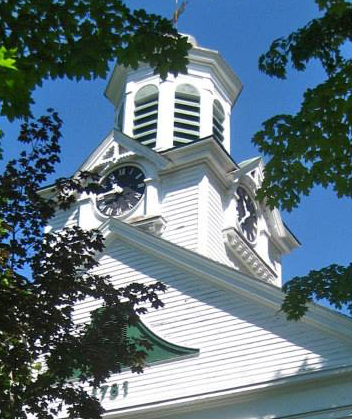
 Community Church of North Orange & Tully