
- Missions Meets on September 20th after Church.
- CROP Walk October 4th in Whately. Join us in walking, donating, and accepting donations!
- Look for a Harvest Supper to arrive in October…
- Morning Walks are now on Thursdays at 10am (instead of Friday).
- Holly Fair: November 28th.
Visit our Calendar of Events to explore our upcoming dates and times
All are Welcome. If you are uncomfortable with the word God, please feel welcome to insert your own word for the divine or Mystery in your life (Universe/Grace/Spirit/Divine).
These Reflections are written to be read aloud, please forgive any writing errors. You can find the recording HERE (usually late Sunday morning).
SUNDAY REFLECTION: Reading: Romans 14: 1-4; 5-10
What a great passage this is from Paul’s letter to the Romans. There’s so much we could say about this, this passage from the assigned lectionary reading for today.
But….we’re not going to talk about it today. Maybe another day. What? What is Charlotte doing this time?
I wanted to bring this Sunday’s reading in because it’s both relevant and, more to the point, Romans 14 is the last section of Romans that is read in the lectionary during its three year cycle. I
What’s the lectionary? That’s a fair question. We don’t all follow the “lectionary” in our beautifully blended Community Church!
The lectionary is the cycle of scheduled readings for each Sunday (or week) of the year. This tradition dates back to Moses and the Torah passages that were read on Sabbath. Christians continued this Jewish tradition.
A system for readings began in the third or fourth centuries and the first “fixed” structure was introduced in the fifth century.
In the 1400’s, we get the printing press and the printed Bible. Common people could get their hands on and read the Bible for themselves.
In the sixteenth century, the Roman lectionary was revised during the Reformation. Martin Luther, in particular, didn’t like many of the Roman Catholic readings and made new choices for the Protestant lineage.
In 1969, we get our standard three year cycle of readings. A. B. C. Mathew, Mark, and Luke predominating each of the years with John peppered in. There is a Hebrew Bible (Old Testament) reading, a Psalm reading, a Gospel reading, and another New Testament reading.
In the 1980’s, we got the Common Lectionary and in 1992, we got our Revised Common Lectionary.
Even now, there are evolving lectionaries, gospels, and Books being read alongside the traditional New Testament Canon.
It is a living, breathing, evolving tradition.
The lovely thing about a common lectionary, is that all around the world Christians are all at the same “table” and reading the same chapter. It connects us and brings us together.
But…you might be wondering who is choosing the readings that we hear, over and over, every three years.
In those first centuries, choosing the common readings was to figure out what would be preached, how it would be preached, and who was allowed to do the preaching (on the flip side: what would not be preached, how it would not be preached, and who would not be allowed to preach).
This was when it was decided who had power and who would keep the purse strings of this growing church.
Who controls how we read and hear the Story? We don’t get the whole Bible in these three years. Not even close, so things get excluded.
Who gets included, which also leads us to ask: who gets excluded? There is always an agenda. Let’s not assume this is a “bad” thing, it just is and it needs to be acknowledged in order for our faith and Story to live and breathe and evolve.
God is Still Speaking was a theme with the UCC to remind us not to get stuck. The lectionary of Romans for today might also encourage us to not get stuck.
If we look closely, the four Gospels are very different, even the three that are most connected (Matthew, Mark, and Luke). The Story shifts depending on when it’s written, what had happened (this helps us to “date” the Gospels), and what is currently going on in society. Where is the writer writing? What community, who, is the writer writing to? The letter to the Romans is going to be different than the letter to the Ephesians or to the Corinthians.
Each minister hears and feels a different Call from God or Grace. Yes, the Story is united and connected, but it is not the same. We might, up on the hill versus downtown, be reading the very same passage, but what’s going on in our community is going to change how we read and share it.
In the reading in your bulletin, I chose to exclude some of the lines of the passage…simply to fit the passage into the bulletin.
So, what does this have to do with the early church leaders? Where are the women? Remember, that was the question we started with.
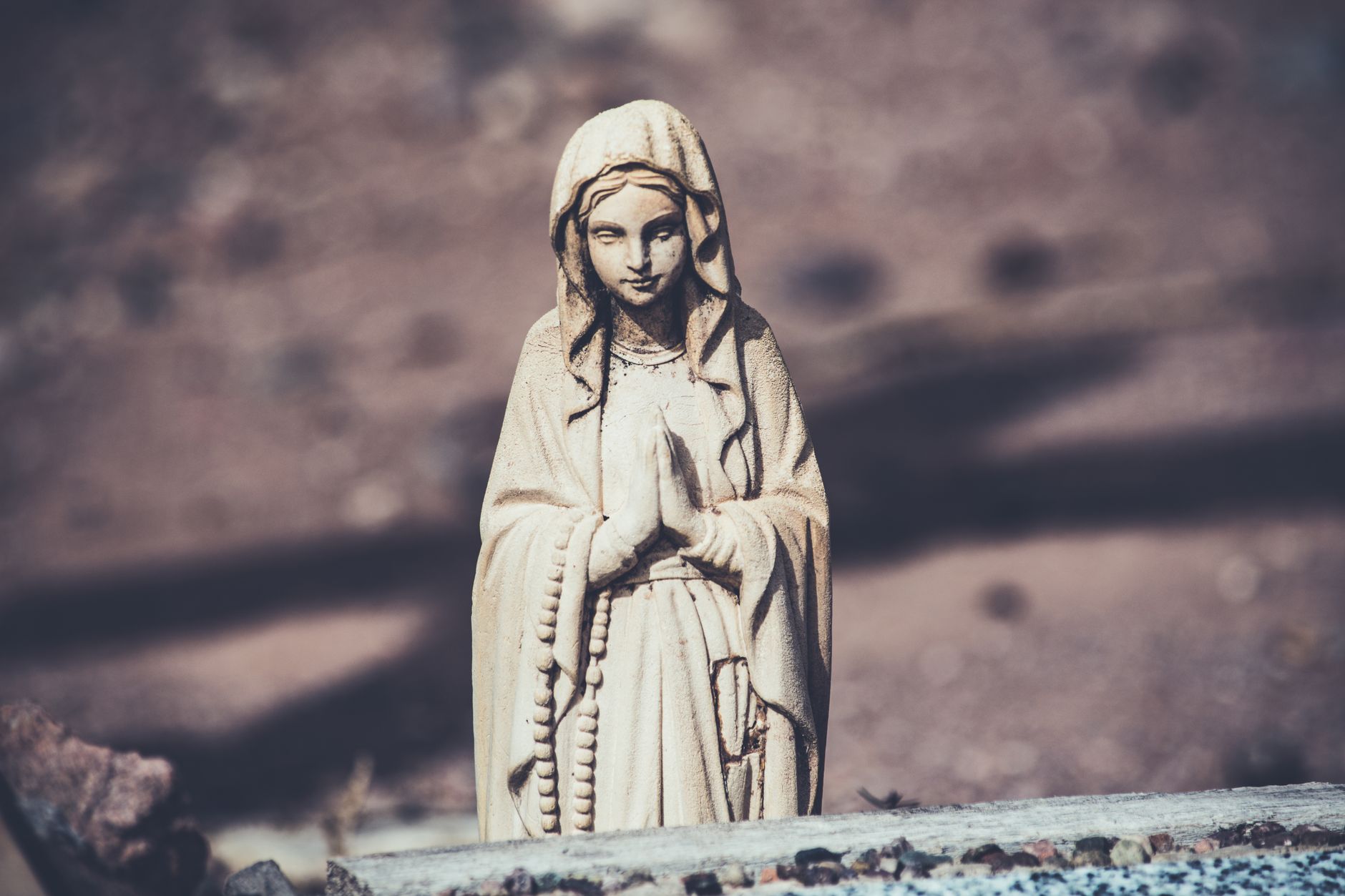
Let’s remember a couple right away. There is no Story at all without Mother Mary. She teaches us of a heart centered faith, a Holy Yes, and that the smallest, poorest, and meekest of us can change the world.
Mary Magdalene. She walked side by side with Jesus. She was called by name. She was at the foot of the Cross,. She is the constant at the Tomb. She is the one Jesus resurrected to. She is the apostle to the apostles.
Dorcas. Let’s bring her up, because she was our first Early Church Leader from a few weeks ago. She was a disciple. And her legacy extends so far that she is a part of our weekly work. And not just us, but all over the world we have Dorcas Societies.
These are some pretty amazing women.
Romans doesn’t end with chapter 14, where the lectionary stops. Let’s read a bit of chapter 16, verses 1-16….(I’m not reading the whole passage, just the relevant pieces):
I commend to you our sister Phoebe, a deacon of the church in Cenchreae. 2 I ask you to receive her in the Lord in a way worthy of his people and to give her any help she may need from you, for she has been the benefactor of many people, including me.
Phoebe is charged with delivering this letter. She will need to interpret it, meaning she is engaged with the ministry, teaching, and preaching. She is a deacon. She is a benefactor, meaning she is independent and has influence.
3 Greet Priscilla and Aquila, my co-workers in Christ Jesus. 4 They risked their lives for me. Not only I but all the churches of the Gentiles are grateful to them.
Prisca or Priscilla is a woman. She is mentioned before her husband, ranking her higher in Paul’s esteem for her work. She risked her neck for Paul and the faith.
5 Greet also the church that meets at their house.
Greet my dear friend Epenetus, who was the first convert to Christ in the province of Asia.
6 Greet Mary, who worked very hard for you.
7 Greet Andronicus and Junia, my fellow Jews who have been in prison with me. They are outstanding among the apostles, and they were in Christ before I was.
Junia went to prison with Paul! Junia is a named apostle. An apostle before Paul was!
8 Greet Ampliatus, my dear friend in the Lord.
9 Greet Urbanus, our co-worker in Christ, and my dear friend Stachys.
10 Greet Apelles, whose fidelity to Christ has stood the test.
Greet those who belong to the household of Aristobulus.
11 Greet Herodion, my fellow Jew.
Greet those in the household of Narcissus who are in the Lord.
12 Greet Tryphena and Tryphosa, those women who work hard in the Lord.
Greet my dear friend Persis, another woman who has worked very hard in the Lord.
13 Greet Rufus, chosen in the Lord, and his mother, who has been a mother to me, too.
14 Greet Asyncritus, Phlegon, Hermes, Patrobas, Hermas and the other brothers and sisters with them.
15 Greet Philologus, Julia, Nereus and his sister, and Olympas and all the Lord’s people who are with them.
16 Greet one another with a holy kiss.
People often ask: where are the women? I usually answer: they are right there, everywhere! Nearly half of the people named in this passage of Romans are women. These are the early church leaders and there is nothing, nothing, to suggest that any of them are doing different work than any of the others.
They are there doing the work. They are everywhere sharing the Way.
We, all of us, are siblings in faith. We are all, each of us, gifted and charged to be leaders in goodness, kindness, and deep courage. Each of us called to fulfill our own faith as we are led by Grace to do in this world to do. Only together, as siblings, can we light the lanterns of peace.

